


At the beginning of the new year, the chemical industry sector, which has been quiet for a long time, has risen strongly. The market trend of "stock market leading, futures and spot resonance" has become a major highlight in the market, and there are signs of recovery in the industry's prosperity.
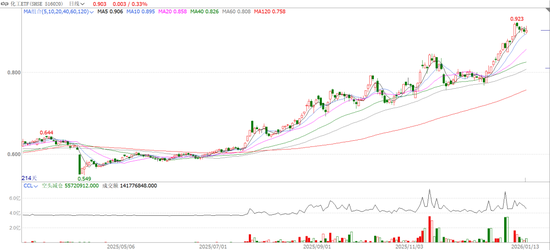
(516020)Daily Chart
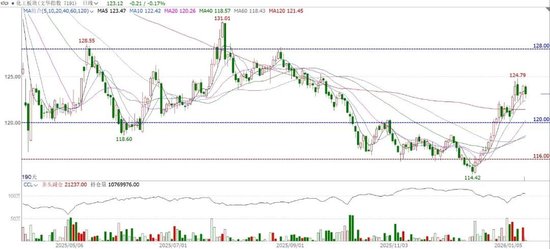
Reporters from the Futures Daily observed that the chemical sector took the lead in starting this round of upward trend in the stock market, with strong willingness of capital to deploy. The core chemical ETF rose by more than 5% in the first week of the year, the cumulative increase of leading products exceeded 10%, and the maximum single-day net inflow surpassed 200 million yuan. At the individual stock level, there was a situation of all-round growth, with the leading stocks in segmented tracks showing a distinct pattern of leading the gains. Sectors such as biochemical engineering, new materials, and refining and chemical industry performed prominently.
The bullish sentiment in the stock market has quickly spread to the commodity market, with chemical varieties following the upward trend and seeing active trading. Among them, energy chain varieties led the gains, forming a certain "stock-futures linkage" effect, but the trends of different varieties still showed differentiation, with those highly correlated with oil prices performing relatively weakly.
Regarding the "stock-futures linkage" rise in the chemical sector at the beginning of the year, market insiders generally believe that this phenomenon is in line with market expectations on the whole, and essentially the result of the quadruple resonance of policies, costs, supply and demand, and capital. The policy side took the lead in setting the tone, injecting a "cardiotonic" into the sector. The Central Economic Work Conference clarified the general tone of stabilizing growth, with the continuation of the "Two New" policies and the unchanged direction of promoting consumption. In addition, the National Work Conference on Emergency Management proposed to eliminate backward processes and equipment and promote the transformation and upgrading of high-risk industries. Some cities also plan to implement differential electricity price increases for backward production capacity. Coupled with the steady advancement of the "Implementation Plan for Carbon Peak in the Petrochemical and Chemical Industry", the capacity clearance of high-energy-consuming varieties will further accelerate.
According to Dong Dandan, chief chemical industry analyst at CITIC Futures, on the cost side, the recent escalation of international geopolitical tensions has pushed up crude oil prices, continuously transmitting cost pressures to the entire industrial chain. A research report from China Galaxy Securities predicts that the price of Brent crude oil futures will trade in the range of $60 - $70 per barrel in 2026, and the stabilization of oil prices after stopping the decline has laid a solid foundation for the profit recovery of the chemical industry. On the supply side, the supply contraction trend at home and abroad is obvious. The domestic chemical industry's capacity expansion cycle is drawing to a close, and the pace of overseas capacity withdrawal is accelerating. Supply gaps have emerged in key areas such as PX. On the demand side, demand is likely to pick up after the Spring Festival. The "15th Five-Year Plan" proposal focuses on expanding domestic demand, and the demand in downstream fields such as new energy, real estate, and automobiles is expected to continue to recover. Coupled with the fact that the United States has started an interest rate cut cycle, which will promote the recovery of overseas demand, the expectation of accelerated demand recovery is strong. On the capital side, the chemical sector, with the advantage of low valuation, has attracted institutional funds to actively enter the market. In the commodity market, investment funds and industrial funds have formed a resonance, jointly driving up the trading popularity of the sector.
A trader asked the reporter: Is this round of market in the chemical sector a phased repair of valuations?
The interviewees agreed that this round of market rally is a phased recovery of valuations, and there may be significant differences between short-term and medium-term trends.
Dong Dandan stated that in the short term (1 to 3 months), the chemical sector has strong bottom support. The peak season of resumption of work in February will further strengthen the expectation of demand growth. The rising geopolitical risks have given a "booster shot" to oil prices, and the effect of policy dividends will also continue to show. It is necessary to continuously pay attention to end demand, the resumption of production of domestic maintenance facilities, etc. In the medium term (3 to 6 months), the internal differentiation of the chemical sector will intensify. The performance of varieties will mainly depend on demand resilience, supply disturbances, oil price trends, etc. The overall sector still needs to wait for a clear signal for a trend reversal.
Xia Congcong, head of the industrial team at Founder Mid-term Futures, believes that chemical varieties are currently in the stage of fluctuating and bottoming out in the industrial cycle. The fundamentals have not yet seen substantial improvement, and the sustainability of price increases is limited. In the short term, market supply and demand remain relatively loose, with some downstream demand being weak. At the same time, there are obstacles to the downward transmission of spot price increases, market participants lack confidence, and upward pressure is gradually emerging. It is recommended to gradually take profits on long positions at low levels. The current one-sided trend is not yet clear, so caution is needed when entering the market.
Overall, the linked rise of the chemical sector at the start of 2026 has kicked off the recovery of the industry, but the market shows significant structural and phased characteristics. Going forward, we need to closely track the implementation effect of macro policies, changes in the supply and demand pattern, and fluctuations in crude oil prices. While seizing the opportunity for valuation repair, we should also do a good job in risk prevention and control," said Xia Congcong.
If you have any inquiries or purchasing needs, please feel free to contact SunSirs with support@sunsirs.com


