

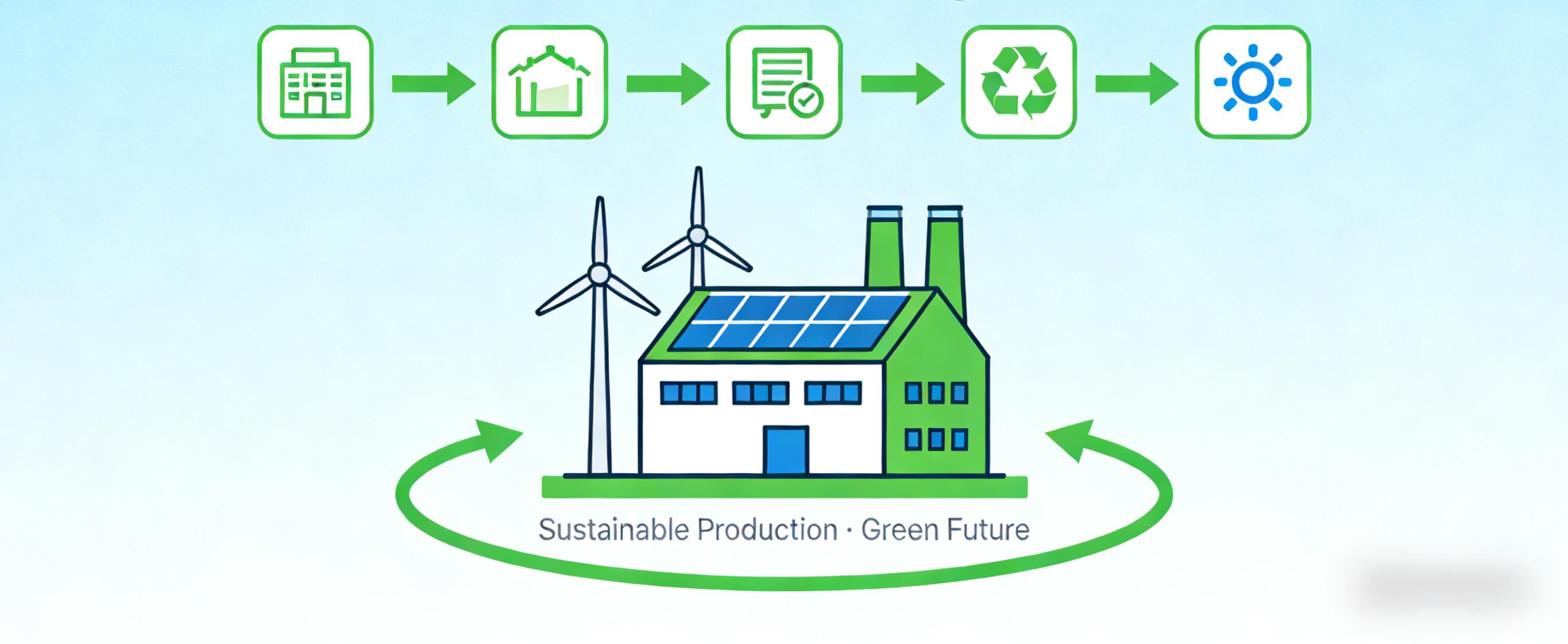
According to the news on the website of the Ministry of Industry and Information Technology on January 19, the Ministry of Industry and Information Technology, the National Development and Reform Commission, the Ministry of Ecology and Environment, the State-owned Assets Supervision and Administration Commission of the State Council, and the National Energy Administration recently jointly issued the "Guiding Opinions on Carrying out the Construction of Zero-Carbon Factories". It is proposed that the construction of zero-carbon factories should follow four principles: implementing policies according to industries and promoting systematically, driving through innovation and empowering with technology, reducing as much as possible and continuously improving, and being unified, standardized, open and transparent.
The main goals of the Guiding Opinions are as follows: implement phased and gradient cultivation, give priority to selecting industries with urgent decarbonization needs, energy consumption mainly based on electricity, and relatively low decarbonization difficulty for pilot exploration, gradually improve relevant planning and design, energy supply, process technology, management and operation, and business models, and then gradually promote to industries with high carbon emission intensity and high decarbonization difficulty when conditions are mature.
Starting from 2026, select a number of zero-carbon factories to set a benchmark and play a leading role. By 2027, cultivate and build a number of zero-carbon factories in industries such as automobiles, lithium batteries, photovoltaics, electronic appliances, light industry, machinery, and computing power facilities. By 2030, gradually expand to industries including steel, non-ferrous metals, petrochemicals, building materials, and textiles, and explore new paths for decarbonization in traditional energy-intensive industries.
   A zero-carbon factory is not absolute.
   Zero carbon dioxide emissions
The construction of zero-carbon factories refers to the process of continuously reducing carbon dioxide emissions within the factory premises and gradually moving towards near-zero through emission reduction measures such as technological innovation, structural adjustment, and management optimization.
An official from the Department of Energy Conservation and Comprehensive Utilization of the Ministry of Industry and Information Technology stated that a zero-carbon factory does not mean absolutely "zero" carbon dioxide emissions. Instead, under the current technical and economic conditions, it should achieve maximum possible emission reductions, continuously improve and enhance, and keep the factory's carbon dioxide emissions at the lowest level.
The person in charge stated that zero-carbon factories are a new thing, and there are still significant differences in understanding from various aspects. Building a zero-carbon factory is a comprehensive and systematic project, involving multiple aspects such as energy structure, process technology, capital investment, and management services. The specific paths, work progress, and implementation difficulties vary greatly among different regions and industries.
The Guiding Opinions elaborates on the construction paths for zero-carbon factories: first, improve the carbon emission accounting and management system to achieve scientific carbon accounting; second, accelerate the green and low-carbon transformation of the energy consumption structure, enhance the utilization of renewable energy and electrification level to achieve carbon reduction at the source; third, improve energy utilization efficiency, accelerate technological transformation and equipment renewal to achieve carbon removal in the process; fourth, carry out carbon footprint analysis of key products, drive the upstream and downstream of the entire industrial chain to implement energy conservation and carbon reduction measures to achieve collaborative carbon reduction; fifth, improve the level of digitalization and intellectualization, carry out precise measurement and refined management and control of energy consumption and carbon emission data to achieve intelligent carbon control; sixth, carry out carbon offset and information disclosure to achieve zero carbon emissions and continuous improvement.
   Improve the relevant standard system for zero-carbon factories
The Guiding Opinions state that, on the premise of ensuring the safe supply of energy and electricity, factories are encouraged to achieve zero-carbon electricity, heat, hydrogen and fuel supply, develop and utilize distributed photovoltaic power, distributed wind power, biomass power generation, etc. in light of local conditions, explore direct connection to green electricity, and increase the proportion of renewable energy use. Factories with conditions are encouraged to build industrial (002265) green microgrids, integrate the application of photovoltaic power, wind power, waste heat recovery, new energy storage, high-efficiency heat pumps, etc., so as to realize efficient multi-energy complementary utilization. Actively develop integrated projects such as green hydrogen, ammonia and alcohol, and promote the application of clean and low-carbon hydrogen such as industrial by-product hydrogen and renewable energy-based hydrogen production. Promote technologies such as electric boilers, electric kilns, electric heating, and ultra-low emission biomass boilers, as well as the replacement of coal-fired self-owned boilers, accelerate the renovation and upgrading of internal operating vehicles and machinery with new energy sources, and improve the electrification level and the proportion of renewable energy for heating (refrigeration).
Next, the Ministry of Industry and Information Technology will work with the National Development and Reform Commission, the Ministry of Ecology and Environment, the State-owned Assets Supervision and Administration Commission of the State Council, the National Energy Administration and other departments to implement the publicity and implementation of the Guiding Opinions, and strengthen overall coordination and policy guarantees.
In addition, we will research and formulate basic and general standards such as general requirements for zero-carbon factories, as well as industry-specific guidelines for the construction and evaluation of zero-carbon factories, and strengthen alignment with international standards. We will accelerate the formulation of standards and technical method guidelines for greenhouse gas emission accounting at the levels of industries/enterprises, processes/units, products, and projects, as well as relevant standards for corporate greenhouse gas information disclosure and product carbon footprint information disclosure.
In terms of promoting comprehensive energy conservation and carbon reduction services, we will gradually improve the market-oriented mechanism for green and low-carbon transformation, promote the application of zero-carbon factory construction in fields such as green consumption, green trade, and green finance, and stimulate the endogenous motivation of industrial enterprises to reduce carbon emissions and develop in a green and low-carbon manner.


